
How-to guide · Beginner · 6 steps · Updated 24 October 2026
How to find eBay dropshippers, and what to learn from them
To find eBay dropshippers, search a busy item and open the stores behind the results. Then look for the signs: a long handling time, thousands of listings in unrelated categories, and titles and photos copied from retail sites. These are signs, not proof. This guide shows five free ways to find such stores and read what they sold. It ends with a short test list, with nothing copied.
Looking for a supplier that ships orders for you instead? Read the guide to wholesale suppliers for eBay.
Steps 1 to 6 work without Productivo. The last part shows how Productivo, the app behind this guide, can help.
Before you start
In shortYou need an eBay account, a computer and one item you might sell.
Who it is for
LevelBeginner
WholesaleEasy
Every step works as written. Step 6 checks each item with your supplier.
ResellingHard
You sell one-off finds, so only steps 4 and 5 apply: what sells, and at what price.
HandmadeHard
You make what you sell, so use step 5 to learn which styles and words buyers want.
Wholesale dropshippingEasy
Every step works. In step 6, check that your supplier carries the item under your agreement.
Thinking of copying a store’s sourcing too? Read the eBay rule first.
- You finish with
- Three to five stores you have checked against the signs, their best sellers, and a short test list of items you can source yourself.
- You need
- An eBay account. eBay may ask you to sign in to see sold items.
- A computer, for Advanced Search
- One item or category you might sell
- A notebook or sheet, and about an hour
How to find eBay dropshippers in six steps
Step 1 tells you what to look for. Steps 2 to 4 find the stores and read their sales. Steps 5 and 6 turn what you found into your own test list.
Step 1 of 6: Learn the signs a store dropships
In shortCheck handling time, item location, catalog size, copied titles and photos, and prices. Each is a sign, not proof.
A dropshipper does not keep the item. Someone else ships it to the buyer. You cannot see that from outside, only signs on the listing and the store.
Two eBay rules make some signs visible. Handling time is the business days from payment to the carrier’s scan. It moves the delivery date buyers see, and eBay recommends 2 days or less. And every listing must state where the item ships from: postal code, city and country.
Five signs, and what else each can mean
Each sign has an innocent reading. Look for several together.Sign It can also be A late delivery date on a common item A small seller who ships twice a week. Items located abroad, under a local store name An importer who holds the stock there. Thousands of listings in unrelated categories A general store that buys stock in bulk. Titles and photos that read like a retail page eBay’s catalog: sellers may use its photos and details. Prices close to big retail sites A seller with low costs who prices to match. One sign alone proves nothing. Look for several together.
Result: Five signs to check on every store, and the rule that one sign alone proves nothing.
Step 2 of 6: Search a busy item and list the sellers
In shortSearch an item you might sell, tick Sold items, and note the sellers who come up again and again.
Start from an item, not a store. Large stores with mixed catalogs turn up in many searches. Pick a common item in a category you know.
Search with Advanced Search
- Open eBay’s Advanced Search. It works on a computer, not in the app.
- Type the item. Under Search Including, tick Sold items.
- Under Item Location, choose US Only, or Worldwide to see sellers abroad too.
- Select Search. Note the seller of each result. If a result does not show it, open the listing. Mark each seller who sold the item more than once.
Sold items shows what buyers paid for. Asking prices on active listings do not. Then run two or three more searches in unrelated categories. A seller who shows up in unrelated searches is your best lead.
Result: A list of five to ten sellers who sold the item lately, and which of them came up in unrelated searches.
Step 3 of 6: Open each store and its other items
In shortOpen each seller’s store, note its listings and categories, and look for one clear line of business.
There are three free ways to reach a seller’s store:
- From a listingOpen one of their items. The seller box links to their store and their other items.
- With the seller lookupType the username into the free eBay seller lookup. It opens their profile and store, items for sale, sold items and feedback.
- With a store searchIn Advanced Search, you can search by Stores instead of Items. Use it when you know part of a store’s name.
On the store page, note four things:
- ListingsHow many items it has. Dropshippers and specialists can both have thousands.
- CategoriesThe category list on the store page. Many unrelated categories is the stronger sign. Car parts for many car models is still one line of business.
- The store nameDoes it say what the store sells? A name that fits none of its items is a sign.
- FeedbackRead what buyers say about delivery. Slow shipping and a package from another company come up here.
Make your call
Use the signs from step 1 and the four notes above.Your call When you see Likely Three or more signs, one of them many unrelated categories under a name that fits none. Unsure One or two signs. Keep the store on your list, but do not count on it. Unlikely One line of business, its own photos and a short handling time, even with thousands of listings. Judge a store by how unrelated its categories are, not by its size.
Result: For each seller: listings, categories, whether the name fits, and your call: likely, unlikely or unsure.
Step 4 of 6: Read what each store sold
In shortSearch each store’s sold items, then write down what sold, how often, at what total price and when.
See one store’s sales
- Open Advanced Search and type an item you saw them sell.
- Under Search Including, tick Sold items.
- Under Sellers, tick Only show items from, choose Specific sellers and enter the username. You can enter several, separated by a comma.
The eBay seller lookup opens all their sold items in one click, with Completed items next to it.
For each item that sold more than once, write down:
- The exact itemModel, size, color and pack count. A 2-pack is a different item.
- Recent salesThe sales in the last 30 days, not the total. Note the other stores that sold it too.
- The total pricePrice plus shipping, as the buyer paid it.
- What did not sellCompleted items minus Sold items: listings that ended without a sale.
Which item is the lead?
Three made-up items, not eBay data. The “sold” number is each listing’s all-time total.Item “Sold” on the listing Sold in 30 days Stores selling it A 1,240 2 1 B 46 19 3 C 310 14 1 A has the biggest “sold” number, but sold only 2 in the last 30 days. C sells well, in one store only. B sold most lately, in 3 stores. An item that sells now, in several stores, is your best lead.
These searches show only sales from the last 90 days. For up to 3 years of sales, from every seller, use Product Research in Seller Hub. It also counts how many sellers sold the item. The Terapeak guide shows how, and the eBay sold listings guide explains each filter.
Count recent sales: the “sold” number on a listing is its all-time total.
Result: A sheet with each store’s top items: the exact item, recent sales, other stores selling it and the total price.
Step 5 of 6: Learn from them, but copy nothing
In shortLearn what sells and what buyers want. Write your own words and take your own photos.
From each store, you may learn:
- Which items sellThe products, versions and price range buyers pay for.
- The words buyers searchWhich words come up in titles that sell. Then write your own title.
- Their delivery promiseHandling time, shipping and returns. Can you offer better?
- What buyers dislikeComplaints in their feedback, such as slow delivery or missing sizes. That gap can be your reason to win the sale.
You may not copy their listing. eBay’s intellectual property policy names “using third-party photos, images, or videos without permission” and “creative text copied from websites, catalogs, or advertisements” as infringing. Stock photos used without permission count too.
eBay’s advice is plain: write your own text and take your own photos. A product in eBay’s catalog is the exception. When your item is in the catalog, you can use its photos and details.
Copy the product idea, never the photos or words.
Result: A note per item: what you learned from the store, and the photos and words you will make yourself.
Step 6 of 6: Turn what you found into a test list
In shortKeep three to five items you can source yourself, check the money left, then list a few.
For each item on your sheet, ask four questions:
- Can you source it yourself?From your own stock, or a wholesale supplier who agrees to supply you. The guide to wholesale suppliers for eBay shows where to look.
- Is the brand protected?Read the brand’s page in eBay’s VeRO participant profiles before you buy stock.
- What is left after fees?Put your cost, shipping and the store’s sold price into the eBay fee calculator.
- Can you beat the store?Faster handling, better photos, clearer details, or a version they lack.
Keep the items with a yes to all four. List a few, and give each the same time before you judge it. The full method, from first search to small test, is in the eBay product research guide.
Drop any item you can only buy from another retailer. The eBay rule below explains why.
Result: A test list of three to five items, each with a source you can use, its money left and your edge.
The eBay rule many of these stores break
In shorteBay allows dropshipping from a wholesale supplier, not buying from another retailer after the sale.
eBay’s dropshipping policy is short. Dropshipping from a wholesale supplier is allowed. But “listing an item on eBay and then purchasing the item from another retailer or marketplace that ships directly to your customer is not allowed on eBay.”
eBay’s enforcement criteria add that you must own the items, or have an agreement with a wholesale supplier, before you list. Another retailer’s or marketplace’s user agreement does not count. eBay can end listings, hide all of them from search, restrict or suspend the account, and keep the fees.
Learn from what these stores sell. Do not copy how they source it. Our guide to the eBay dropshipping policy explains what is allowed.
Mistakes that cost sellers money
In shortMost of these come from copying a store instead of learning from it.
Five mistakes and what they cost
| Mistake | What it costs, and what to do |
|---|---|
| Copying photos or text | A rights owner can report it. eBay can remove the listing or restrict the account. Instead, take your own photos and write your own words. |
| Judging a store by its size | You study specialists and miss the stores you meant to find. Instead, count unrelated categories first. |
| Trusting the “sold” number | You stock an item that stopped selling long ago. Instead, count sales from the last 30 days. |
| Copying a long handling time | Your delivery date moves back on every listing. Instead, set 2 days or less, as eBay recommends. |
| Copying the sourcing | eBay can hide every listing and suspend the account. Instead, use your own stock or a wholesale supplier. |
Common questions about eBay dropshippers
How do I find dropshippers on eBay?
Search a busy item with Sold items ticked, then open the stores that come up in several searches. Check each store for the signs in step 1. Steps 2 and 3 show the searches.
How can you tell if an eBay seller is a dropshipper?
You cannot be sure from outside, but several signs together point to it. Look at handling time, item location, a huge catalog in unrelated categories, copied titles and photos, and retail prices. One sign alone proves nothing.
Are big eBay stores always dropshippers?
No. In the store data in step 3, the big stores judged not to dropship had more listings than those judged to dropship. What set them apart was one line of business, not size.
Is it allowed to look at another seller’s sales on eBay?
Yes. eBay’s own Advanced Search lets anyone see sold items from a specific seller. What you may not do is copy their photos or text. Step 5 draws the line.
Can I copy a dropshipper’s listings on eBay?
No. You may sell the same product, but write your own words and take your own photos. eBay’s intellectual property policy bans copied photos and text. A product in eBay’s catalog can use the catalog’s photos.
Do I need a tool to find eBay dropshippers?
No. Advanced Search, store pages and the sold filter are free. A tool saves time when you check many stores at once. Product Research in Seller Hub adds up to 3 years of sales.
How do I find a dropshipping supplier for eBay?
Look for a wholesale supplier who agrees to ship orders for you. The guide to wholesale suppliers for eBay shows where to look and what to ask.
How Productivo helps you find dropshipping stores
In shortProductivo can find and read many stores at once, but its sourcing half does not fit eBay’s rule.
Everything above works with eBay’s own tools. This part is about Productivo, the app behind this guide.
Where Productivo fits in the steps
| Guide step | What Productivo does |
|---|---|
| Step 2 | Competitor research reads the results pages of eBay categories you pick. It notes which stores turn up in the most categories. |
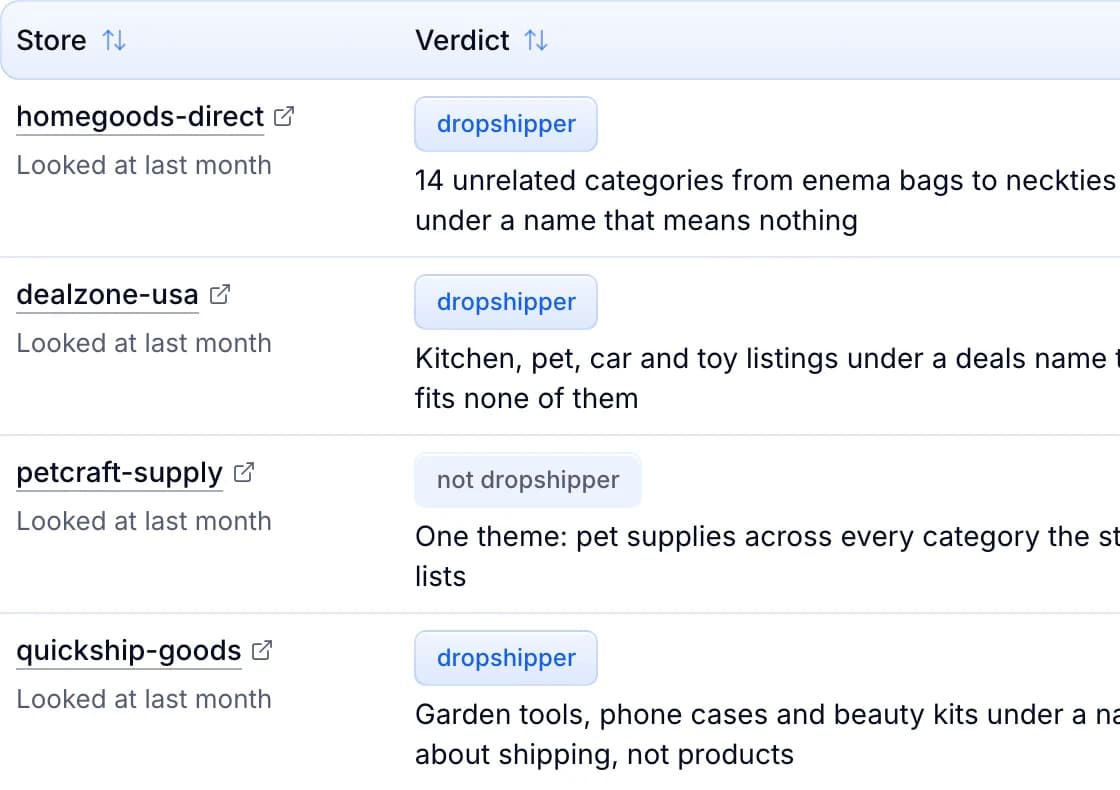
| Step 3 | It opens the stores among them with 500 or more feedback, most categories first. A store with 3,000 or more listings gets an AI verdict: dropshipper, not a dropshipper or unsure, with its reason in one line. |
| Step 4 | It reads each dropshipper’s sold listings, newest sales first, with how many sold. The Chrome extension scans one store you open yourself. |
Stores with their verdict and reason
Each store shows its verdict and the reason in one line. The full screenshot adds its categories, listings, sales and feedback, and Show items opens what it sold.
Where it does not fit: after the store part, it looks for each sold item on Amazon and works out the profit at Amazon’s price. Buying from Amazon after the sale breaks the eBay rule above. It has no wholesale supplier search, and it never copies a competitor’s photos or text.
Competitor research is part of the Basic, Pro and Scale plans, with 1,000, 5,000 or 15,000 product checks a month.
Written by the Productivo team. Source review: eBay’s Advanced Search form and its help page, delivery date options for sellers, item location policy, intellectual property policy, VeRO participant profiles, Product Research help, dropshipping policy and its enforcement criteria, checked 24 October 2026. The signs are what a buyer or seller can see from outside. None of them proves how a store sources.