
How-to guide · Beginner · 6 steps · Updated 18 October 2026
eBay pricing strategy: set a minimum price and repricing rules
An eBay pricing strategy is a plan for your prices: what to charge, and when to change it. This guide starts with your minimum selling price. That is the lowest price that still leaves you money after every cost. Then you write a few repricing rules. Each rule moves your price when something changes, but never below that minimum.
New to this? Follow the example first. It prices one item from start to end. Already know your costs? Work out your minimum price now.
Steps 1 to 6 use only eBay’s own tools. The last part shows how Productivo, the app behind this guide, can help. You do not need a Productivo account for the steps.
Before you start
In shortCheck that you sell the item at a fixed price, and have its costs and recent sold prices ready.
Who it is for
LevelBeginner
WholesaleEasy
The steps work as written. Many sellers list the same item, so step 4’s competitor rules fit well.
ResellingMedium
Steps 3 and 4 need care: compare only items in the same condition. A one-off item may have no exact competitor.
HandmadeMedium
Steps 3 and 4 need care: compare similar items that sold. Few sellers have your exact item, so competitor rules rarely apply.
Wholesale dropshippingMedium
Steps 4 and 6 need care: your supplier’s price and stock can change any day. Check them often, and work out your minimum again.
Selling by auction? These rules are for fixed prices. In an auction, a reserve price sets the lowest price you accept. Common questions has more.
- You finish with
- One item with three prices: a minimum, a normal and a maximum price. Plus five or six written rules that say when the price moves.
- You need
- An item you sell, or plan to sell, at a fixed price (Buy It Now)
- What you paid for it, and what it costs to ship to a buyer
- What the same item sold for lately. The eBay product research guide shows how to find it.
- A calculator and about 30 minutes
Worked example: price one item, step by step
In shortHold your price at your minimum when a competitor goes lower, as the BT-7 does at $24.00.
This is an eBay pricing strategy for one made-up item. The item, costs and prices are not real. You will not find them on eBay.
The BT-7’s minimum price
| Per item | Amount |
|---|---|
| Buy the light and ship it to you | $10.00 |
| Shipping to the buyer | $5.00 |
| Packaging | $0.60 |
| Money kept for returns | $0.40 |
| eBay’s per-order fee | $0.40 |
| Money you want left | $4.00 |
| Total to cover | $20.40 |
| Minimum price: $20.40 ÷ 0.85 | $24.00 |
Similar new lights sold for about $29 to $35, with free shipping. So the normal price is $29.99 and the maximum is $34.99. Both are above the $24.00 minimum.
The rules at work for five days
The BT-7 against its cheapest competitor. The shaded band runs from your minimum to your maximum.
- Day 1
- Day 2
- Day 3
- Day 4
- Day 5
- Your price
- Held at your minimum
- Cheapest competitor
On day 3, the competitor drops under your minimum. Your price stops at $24.00 and waits there. When they sell out, it goes back to $29.99.
A drawing, not eBay’s screen. Made-up prices.
What the six rules do to the BT-7’s price
| What happens | New price | Money left |
|---|---|---|
| No cheaper competitor | $29.99 | $9.09 |
| The cheapest competitor asks $28.50 | $28.00 | $7.40 |
| The cheapest competitor asks $20.50, below your minimum | $24.00 | $4.00 |
| Only two left, no new stock soon | $29.99 | $9.09 |
| No sale in 30 days at $29.99 | $27.99 | $7.39 |
| Sold out within a week at $29.99 | $31.99 | $10.79 |
Two checks before the rules go live
A sale must stay above the minimum too. A 20% sale on $29.99 gives $23.99. That is under $24.00. So a sale on the BT-7 can be 19% at most.
Ads raise the minimum. Promote the BT-7 at a 5% ad rate, and its minimum becomes $25.67.
Now do the same for your own item. Follow the steps below.
How to price items on eBay with a minimum and rules
Build your eBay pricing strategy on one item you sell often. Then use the same steps for the rest of your store.
Step 1 of 6: Add up your costs for one sale
In shortList what one sale costs you, including shipping, and count eBay’s fee as 15% of the price.
Your price has to pay for everything one sale costs you. Write down each cost per item:
- What you paid for the item, with shipping to you
- Shipping to the buyer, even when the buyer sees free shipping
- Packaging
- Money kept for returns: a little per item for refunds and return shipping
- eBay’s fees, and ad fees if you promote the listing
On eBay.com, the final value fee is eBay’s main fee. For most categories, it is 13.6% of the total the buyer pays. That total includes the item, shipping and sales tax. eBay also takes $0.40 per order, or $0.30 if the order is $10 or less. After 250 listings in a month, each further listing also has an insertion fee. Some categories have other rates. Check the current eBay fees for yours.
Sales tax makes the fee a bit more than 13.6% of your price. This guide counts the fee as 15% of your price. That covers sales tax up to about 10%.
Your costs depend on how you get your stock. Count them the same way for wholesale stock, second-hand items or things you make.
Result: Every cost of one sale, written down. The fee and any ad rate are percents.
Step 2 of 6: Work out your minimum selling price
In shortAdd the money you want left to your costs, then divide by what the percent fees leave, like 0.85.
Your minimum price is the lowest price you will sell at. Below it, a sale leaves too little money, or loses money.
- Choose the least money you want left per item. It still has to pay for your time, other business costs and income tax.
- Add it to the costs from step 1, without the percent fees.
- Divide by what the percents leave. With the fee at 15%, divide by 0.85. With a 5.5% ad rate too, divide by 0.795.
- Round up to the next cent.
The BT-7 example works it out line by line. Write your minimum down, and never sell below it. Every rule, offer and sale in this guide stops there.
Costs change. A new supplier price, shipping rate or ad rate changes your minimum. Work it out again each time.
Result: Your minimum price for this item, worked out from your own costs.
Step 3 of 6: Choose your normal and maximum price
In shortPick a normal price among recent sold prices, above your minimum, and a maximum near the top.
Start from what buyers paid for the same item. Use sold prices. An asking price is only what a seller hopes to get. The eBay sold listings guide shows how to see what items sold for.
In many categories, the listing form also shows pricing insights from eBay. Check them against the sold prices you found.
Compare the total each buyer paid: the price plus shipping. eBay says more than 70% of its sales ship free. Buyers like one simple price. So many sellers put shipping into the price.
Your normal price is what you ask on a regular day. Put it among the sold prices of the same item. Your normal price must be above your minimum. If it is not, the item does not work at today’s costs. Lower a cost, or pick another item.
Your maximum price is the most you will ask. Keep it near the highest sold prices you found. Rules may raise your price, but never above it.
Price also matters in eBay search. Best Match, eBay’s normal sort order, looks at the price of the item.
Result: Three prices for one item: minimum, normal and maximum.
Step 4 of 6: Write your repricing rules
In shortFollow the cheapest seller of the same item 50 cents under, but never below your minimum.
A repricing rule says when your price changes, by how much and where it stops. Five or six rules are enough. Start with these, and change the numbers to fit your item.
- Follow the cheapest competitor. Price 50 cents under their total. A competitor is another seller of the same item.
- Never go below your minimum. If they are cheaper than that, stay at your minimum and wait.
- No cheaper competitor? Use your normal price.
- Low on stock? Stop following. With two or fewer left and no new stock soon, sell at your normal price.
- No sale in 30 days? Check the listing first. Use the eBay listing checklist. Then lower the price by $2, but not below your minimum.
- Sold out fast? Go up in small steps. Next time, add $2, up to your maximum.
Only follow the same item: same model, condition and pack size. A used one, a two-pack or an older model is a different item. Leave it out, even when it is cheaper.
Write your rules down before you use them. Then each price change has a reason. The worked example shows these rules at work.
Result: Five or six written rules. Each says when, how much and where to stop.
Step 5 of 6: Keep offers and sales above your minimum
In shortSet the Minimum offer amount at or above your minimum price, and check each sale before it starts.
Offers and sales lower what a buyer pays. So check each one against your minimum.
Best Offer
With Best Offer, buyers can offer you a lower price. In the listing form, turn on Allow offers. Then set a Minimum offer amount. eBay declines lower offers for you. Set the minimum offer amount at your minimum price or higher.
You can also set an Auto accept amount. eBay then accepts offers at or above it for you. It must be below your Buy It Now price. Not every category allows these automatic answers. When a rule lowers your price, check that the Auto accept amount is still below it.
Offers you send
In Seller Hub, you can send offers to buyers who watch your item or put it in their cart. Each offer must be at least 5% under your Buy It Now price. It must still be at or above your minimum.
You can also send these offers automatically. An automatic offer keeps its discount when your price changes. So when a rule lowers your price, the offer goes down too. Check that it still stays at or above your minimum. If your price drops below the offer, eBay pauses the offers.
Sales and volume pricing
With an eBay Store subscription, Discounts Manager in Seller Hub adds more ways to lower a price. A sale event lowers prices for a set time. Volume pricing gives a discount when a buyer takes more than one. Work out the lowest price each discount gives. It must stay at or above your minimum.
A coupon can stack on a sale event and a shipping discount. So work out the price with all of them at once. After a sale event starts, you can change its end date and name, but not the discount.
Discounts do not lift a listing in search by themselves, eBay’s sale events FAQ says. Each sale made with one still counts for that listing.
Result: Offer and sale settings that never go below your minimum price.
Step 6 of 6: Check your prices every week
In shortLook at each item’s costs and sales, change one number at a time, and write down why.
An eBay pricing strategy needs a check. Pick one day a week. Look at each item’s sales, price and money left.
- Did a cost change? Work out the minimum price again.
- Is a price stuck at your minimum for weeks? The item may not work at your costs. Find a lower cost, or stop selling it.
- Did a price change bring sales? Keep the rule. If not, change one number, not five.
Give each new price time to get sales. A slow item may need a few weeks. Change one thing at a time, so you know what worked.
Keep a short price log: the date, the old price, the new price and why. Then you can see which change helped.
Result: A weekly review day and a short price log.
eBay pricing strategy mistakes to avoid
In shortCompare buyer totals for the same item, and work out your minimum again whenever a cost changes.
- Compare totals, not item prices. A $30 item with $6 shipping costs the buyer more than a $34 item with free shipping.
- Follow only the same item. A cheaper used or older one is not your competitor.
- Wait at your minimum when a competitor goes lower. Their stock may run out, or their price may go back up.
- Check every sale and offer against your minimum. In the example, a 20% sale on $29.99 gives $23.99. That is below the $24.00 minimum.
- Work out the minimum again when a cost changes. An old minimum can hide a loss.
- Group very cheap items. eBay’s $0.30 order fee is the same on a $1 order as on a $10 one. Sell several cheap items together in one listing.
Common questions about eBay pricing strategy
What is a good pricing strategy for eBay?
Price from sold prices, and protect a minimum. Find what buyers paid for the same item. Work out the lowest price that still leaves you money. Then use a few simple rules. Check them every week, because costs and competitors change. A good eBay pricing strategy is one you can keep up.
How much does eBay take from a $100 sale?
$14.00, in most categories, when the buyer pays $100.00 in total. eBay takes 13.6% of the total plus $0.40 per order. The total includes shipping and sales tax. If you promote the listing, your ad rate comes on top. The eBay fee calculator works out the fees and profit for your own price.
How do I set a minimum selling price on eBay?
For a fixed price, the minimum is your own rule. Step 2 shows how to work it out. With Best Offer, set a Minimum offer amount. eBay then declines lower offers for you.
In an auction, start the bidding at the lowest price you will accept. You can also set a reserve price, the lowest price you accept. It costs $5 or 7.5% of the reserve, whichever is more, up to $250. You pay it even if the item does not sell.
Should I start with a high price and lower it?
Yes, if you start within recent sold prices and lower in small steps. A price far above what sold may not sell. With the rules from step 4, you lower it by $2 after 30 days without a sale, and never below your minimum.
Why do some sellers ask 2 to 3 times the going rate?
An asking price is not what buyers pay. Search the sold prices of the same item. If the high price is not among them, it is not a market price. Some of these listings take Best Offer, so buyers may pay less than the listing shows. Product Research shows what they paid, even after a Best Offer. Do not follow these prices. Keep your maximum near the highest sold prices you found.
Should I offer free shipping on eBay?
Often, yes, if your price covers it. eBay says more than 70% of its sales ship free. Its fee is a percent of the total, and the total includes shipping. So moving shipping into the price does not change the fee. Your minimum price must still include the shipping cost.
How often should I change my eBay prices?
Check them once a week, and change them by a rule. Also check when a cost changes. Small steps are easier to judge than big jumps. Give each new price time to get sales before you change it again.
How can I see the price of an accepted Best Offer?
Use eBay Product Research in Seller Hub. It shows what the buyer paid, even when the seller accepted a Best Offer. The eBay product research guide shows how to use it.
Do I need an eBay repricing tool?
Not for a few listings. You can check them by hand once a week. Repricing tools, also called dynamic pricing tools, change prices for you. They help when you have many listings, or prices change every day. With any tool, check two things. What does it count as the same item? And does it ever go below your minimum?
How Productivo helps with your eBay pricing strategy
In shortProductivo can apply rules like these to many listings, and never prices below your minimum profit.
Everything above is an eBay pricing strategy you can run with eBay’s own tools. This part is about Productivo, the app behind this guide.
Where Productivo fits in the steps
| Guide step | What Productivo does |
|---|---|
| Step 1 | Settings › Pricing keeps the costs of each store: eBay’s fee, sales tax, your ad rate and any extra costs. |
| Step 2 | Your minimum profit works like a minimum price. No price goes below it, whatever competitors do. |
| Step 3 | Profit bands work out the normal price from the item’s cost. Each price range, and each eBay category, can have its own profit. |
| Step 4 | Competitor pricing follows the cheapest matching seller, 2% under unless you change it. Smart Repricer tests prices up and down and keeps the one that earns the most a day. |
| Step 6 | Review and save shows how many listings would change before anything reaches eBay. The Price updates switch stops every price change for a store, while stock updates go on. Reports show each order’s profit after eBay’s fees and ad charges. |
Competitor pricing is part of every plan. Smart Repricer is turned on for your account when you ask. Both price the products whose cost Productivo reads from Amazon. A product you add by hand keeps the price you give it.
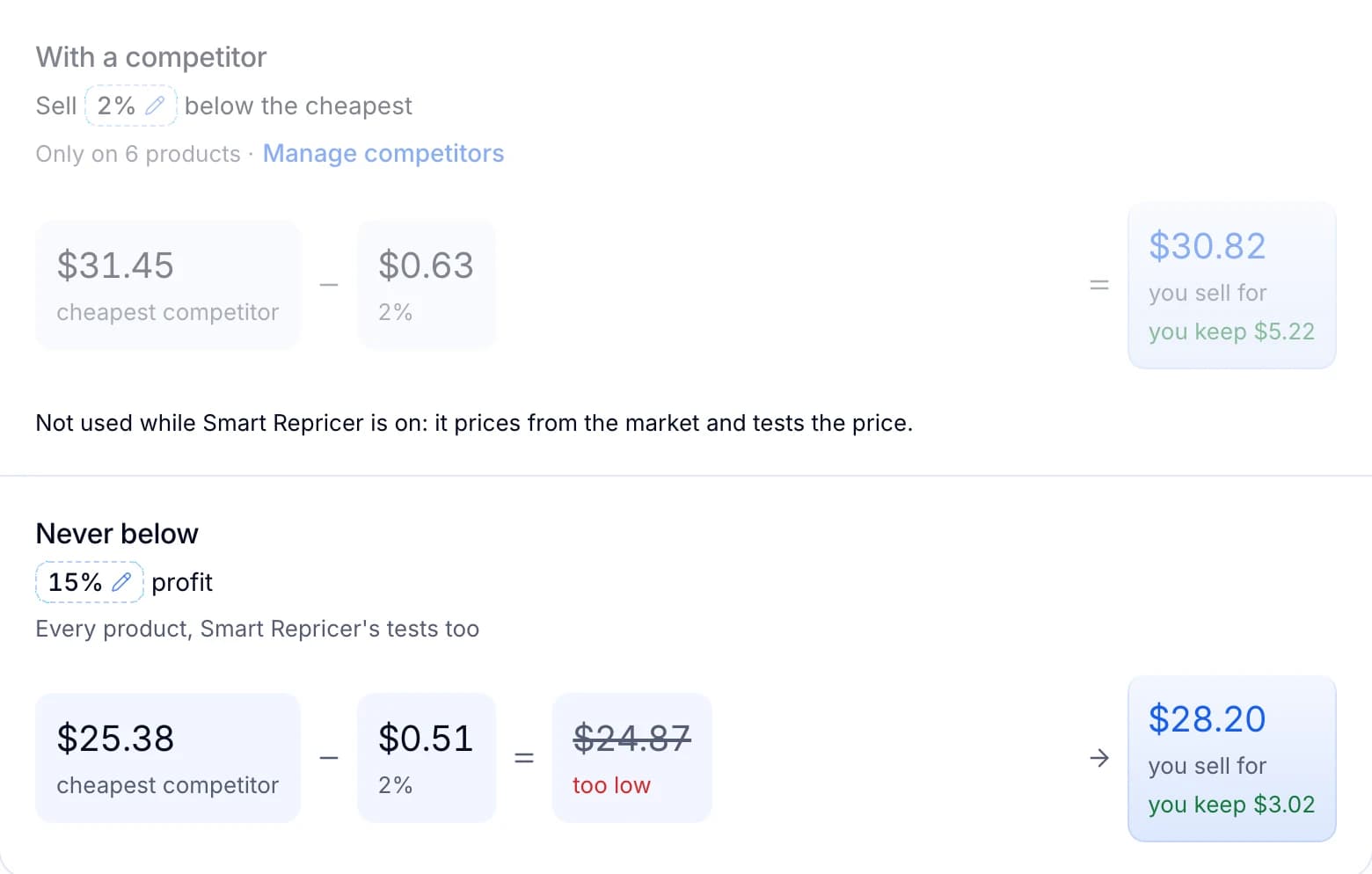
Never below your minimum, in Productivo
Here the cheapest competitor asks $25.38. Following them would mean $24.87. That is under the 15% minimum profit. So the price stays at $28.20.
Productivo also has pages for wholesale stock, second-hand goods and handmade products.
Written by the Productivo team. Source review: eBay’s selling fees, Best Offer and offers to buyers, Promoted Listings general campaigns, Discounts Manager, sale events FAQ, Best Match, How to price your items and Product Research documentation, checked 18 October 2026. The numbers in the example are made up.